

The hard chrome plating on the hydraulic cylinder rod is the key to its safe and effective operation. Over time, this plating wears down, impacting the rod’s performance and durability. Rechroming these rods is critical to restoring efficient operations and protecting the substrate against further damage.
Applying hard chrome plating to a hydraulic cylinder rod is a complex process. It requires specialized expertise and equipment to ensure the chrome has the desired thickness and surface finish. When done correctly, rechroming hydraulic cylinder rods is well worth it due to its durability and cost savings.
Should You Chrome Plate Hydraulic Cylinder Rods?
The short answer is yes. Hydraulic cylinder chrome plating is crucial for restoring hydraulic cylinder performance and durability. It can prevent costly replacements and boost the hydraulic system’s efficiency. The longevity of hard chrome plating varies depending on the environment, and hydraulic cylinders often require repairs more frequently. Chrome plating the rods can reduce the need for these repairs.
Industrial hard chrome plating differs greatly from the decorative chrome on performance vehicles. The main difference is the thickness of the chrome. Hydraulic cylinder rod chrome plating thickness is considerably higher than that of decorative finishes. Its durability, wear and corrosion resistance are useful in many applications. It is common in hydraulic cylinders due to its low friction coefficient in metal-to-metal moving parts.
The Benefits of Rechroming Hydraulic Cylinder Rods
Hard chrome plating creates a protective barrier for the hydraulic cylinder. Rechroming offers the following benefits:
- Increased hardness: Rechroming a hydraulic cylinder rod increases its surface hardness without modifying its properties.
- Reduced friction: Hard chrome has a low friction coefficient, allowing components to operate at lower temperatures and increasing their useful life. The lower the friction in your system, the more efficient your operations and the lower your energy consumption.
- Enhanced wear resistance: The high hardness and low friction of rechroming provide excellent abrasion resistance. Hydraulic cylinders and pistons are standard in various industrial applications, including heavy machinery, automotive manufacturing and material handling. These applications make them prone to wear, which is another reason why rechroming is a cost-effective choice.
- Corrosion resistance: Hard chrome has high resistance to atmospheric oxidation and good resistance to many chemicals, maintaining durability over time.
- Extended useful life: Chemical strippers can remove hard chrome without damaging the substrate, so you can strip and replate the cylinder rod as often as needed. The structure underneath remains intact, which increases the component’s longevity. You can sometimes rechrome the rod more than once, provided it’s well-maintained and in good condition.
- Improved performance and reduced downtime: Rechroming a hydraulic cylinder rod improves the cylinder’s overall performance and reduces the need for repairs and replacements. You can enjoy extended uptime and the associated profitability from your components.
- Reduced costs: Instead of replacing the entire hydraulic cylinder at the first sign of wear, rechroming offers an alternative solution that delivers the same performance.
- Long-term return on investment: Besides immediate cost savings, rechroming hydraulic cylinder rods makes your operations more sustainable. You can reduce the frequency of replacements and lower overall maintenance expenses, saving money and minimizing downtime.

When to Rechrome Hydraulic Cylinder Rods
Hydraulic cylinder rods need rechroming at the first sign of defects or wear and tear. Look for the following indications:
- Surface damage: The rod seals’ useful life is reduced if the chrome surface is pitted or scored. You may be able to buff out light scratches, but if the chrome is badly pitted or scored, it is time for rechroming or replacement.
- Corrosion or oxidation: Any signs of rust or chemical corrosion could lead to complete cylinder rod failure, and your rod may need replacing.
- Issues from the previous plating process: Some issues can occur during the plating process, including blistering, burned deposits, cracking or milky deposits. These issues may affect the result, and the rod may need rechroming.
The Rechroming Process
If your cylinder rod needs to be rechromed, it goes through the following process:
- Cylinder inspection: Experts will inspect and evaluate the rod to determine its condition before plating. They will look for any signs of damage that could affect the process. If necessary, they will recommend replacement instead of rechroming.
- Stripping and grinding: Before adding the new chrome plating, the experts will remove the previous one. This step is either completed in a reverse-electrolysis process or with a large grinding machine, as preserving the substrate is essential. They used specialized equipment to complete it to ensure no damage to the rod.
- Substrate cleaning: Once the old chrome is removed, your team will clean the substrate surface, removing all debris and contaminants. This step is crucial to prevent anomalies during the plating process.
- Chrome plating: The rod is placed in a bath containing a solution of dissolved metal molecules. Then, your team attaches electrodes to the rod and applies a positive current to the solution, allowing the metal particles to attract and adhere to its surface. Deposit your application’s chrome thickness, which requires precise bath chemistry and current flow control. Once the chrome is deposited, it provides all the benefits with an aesthetically pleasing finish.
- Post-grinding: Once the chrome plating experts have added a new chrome layer, they use a grinding machine to get the chrome surface to the desired thickness.
- Finishing: This is a careful process of sanding the cylinder, measuring in fractions to millimeters to get the correct chrome thickness and surface finish. Again, the operators use specialized finishing equipment to ensure complete accuracy, precision and quality.
- Post-plating inspection: Professionals inspect the rod to ensure the thickness and surface finish meet stringent quality standards. If it does, the cylinder rod is ready for use and will be carefully packed and returned to you.
Extend the Useful Life of Your Hydraulic Cylinder Rod With Hard Chrome Specialists
Rechroming hydraulic cylinder rods is critical for maintaining safe, efficient and cost-effective operations. With Hard Chrome Specialists, you can see the benefits of hard chrome plating and repairs for your industrial components. Since 1988, we have maintained our commitment to solving our customers’ most technical and complex requirements.
As a recognized industry leader with decades of hard chrome plating experience, we are dedicated to continuous improvement and meeting exacting quality control standards. Friendly, honest customer service is at the heart of everything we do. We pride ourselves on giving you peace of mind that your equipment will withstand the harshest operating environments. Contact us to learn more about our rechroming and repair options today!

Advantages of OD Grinding
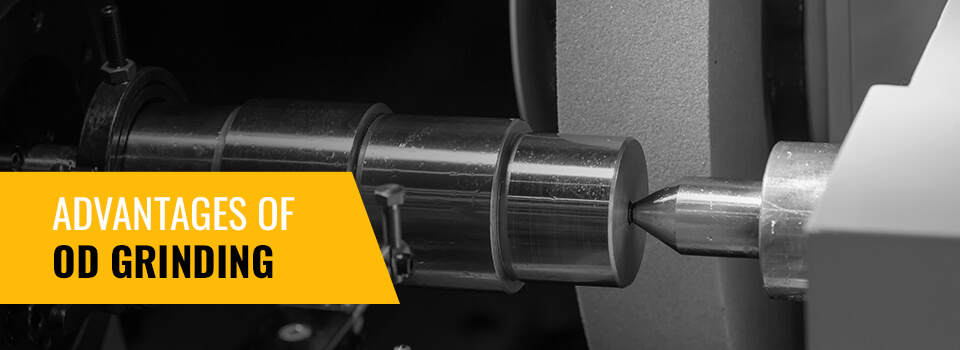
Outside diameter (OD) grinding is a highly effective and often-used process for metalworking jobs — and for many reasons. If a project you’re working on requires strict precision and near-perfect part roundness, you can achieve this easily with an OD grinder. Learn more about this grinding technique, including common OD grinding applications and the main benefits of OD grinding.
What Is OD Grinding?
OD grinding is a subset of cylindrical grinding that finishes a part’s outside diameter. Cylindrical grinding is a process typically used at the end of a project that forms a finished surface on a cylindrical part’s interior, exterior or both. With cylindrical grinding, the object and grinding wheel continually rotate with respect to each other.
During OD grinding, the part being finished spins on a central rotational axis. OD grinding uses two end pieces to hold the part steady, with it rotating around its true center axis. The grinding wheel also rotates, often while traveling the length of the component.
Both the part and wheel move in the same direction, but when they make contact, the direction is reversed, and they begin moving opposite to each other. This technique lessens the chance of a jam, helps both objects travel smoothly and prevents the grinding wheel from making any significant cuts within the material being ground.
Various components of an OD grinder can be offset during the process to ensure different results, such as:
- The grinding wheel: Offsetting the grinding wheel lets you grind certain angles onto a part.
- The headstock: If you’re looking to create a more pronounced taper on a part, offsetting the grinder’s headstock will help you achieve this.
- The upper table: Offsetting the upper table facilitates extremely accurate and gradual taper grinding, where one end of the part becomes smaller than the other end.
What Is an OD Grinder Used For?
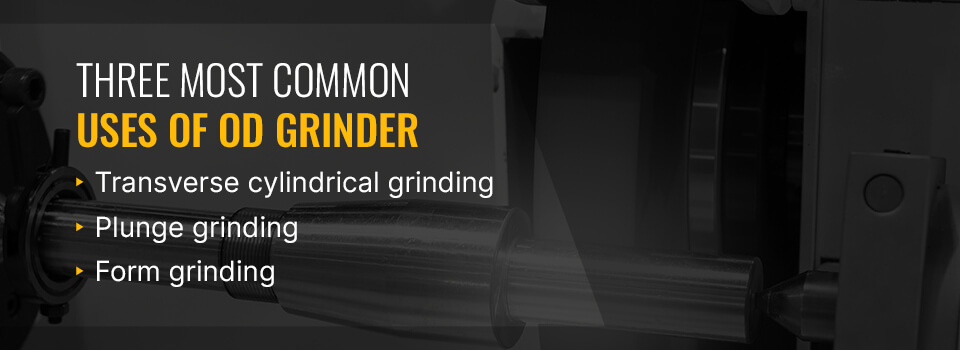
OD grinders are used for finishing the exteriors of objects like crankshafts, bearings, axles and hydraulic and transmission components. OD grinding is a go-to choice when metalworking jobs require close attention to detail, accuracy and precision. You can perform numerous grinding jobs using an OD grinder. Here are the three most common uses:
- Transverse cylindrical grinding: Transverse grinding adds transverse motion across the part being finished, which is relative to the grinding wheel and moves perpendicular to the plane of wheel rotation. This type is essentially the opposite of plunge grinding, described below.
- Plunge grinding: During plunge grinding, the wheel continuously makes contact with one section of the part instead of traveling up and down its length.
- Form grinding: The wheel is the same shape as the finished part with this type of grinding, allowing you to grind non-standard forms.
Benefits and Advantages of OD Grinding
While OD grinding has numerous benefits, one significant advantage is that you can find an object’s true center using this process, which allows you to create a perfectly circular shape. This ability is especially crucial for industries and applications that call for precise parts.
OD grinding can also remove existing geometric issues on a part and bring it back to the level of accuracy and roundness you need. This feature makes it an excellent option for addressing metal component defects so you can spend less time creating entirely new parts.
OD grinders come in several configurations to best match your project needs. For example, you could use a computer-numerical control (CNC) model or a manual machine. Manual grinders are often better for accomplishing custom material cuts, while automated models let you complete more work with less labor.
You can easily complete large, complex projects with a suitable grinding machine and metalworking partner to take care of the process. At Hard Chrome Specialists, our cylindrical grinding machine can take on projects as big as 25 inches in diameter and 159 inches long. Our machine can also handle a weight capacity of up to 8,000 pounds. With these capabilities, you can be confident your projects will turn out just as intended, whether small or large.
What Industries Is OD Grinding Used For?
Precise engineering and adherence to strict measurements are essential aspects of many different industries and their machine production processes. Here are some common industries and applications that use OD grinding to meet these standards:
- Aerospace: Aerospace components must withstand extreme environments, including significant vibration, very high and low temperatures and high altitudes. They also have small tolerances and must have precise finishes. OD grinding is the preferred way to produce elements like turbine shafts and rings, tensile specimens, valves and spools that meet these requirements. Precision grinding ensures components used in aerospace engineering meet the required specifications for temperature stability, safety, flexibility and rigidity.
- Machine tooling: Manufacturers use OD grinders to make parts like pistons, roller bearings, spindles and ball screws. OD grinding is also used to create components such as drill points, ring gages, profile inserts and reamers for the machine tooling and die and mold sectors.
- Automotive: Within the automotive industry, manufacturers use OD grinding to shape parts like brake cylinders and pistons, gear shafts, connecting rods and steering pistons. The precise finishes they can achieve with this method offer a perfect fit for mated automotive components like gears. Part concentricity is crucial for many vehicle elements, and OD grinders are ideal for accomplishing the required concentricity level.
- Defense: Like the aerospace sector, components used for the military and defense industries must meet precise specifications and hold up to rigorous use and harsh settings. Some elements that benefit from OD grinding are missile shells, gun tripods and bolt carrier groups.
- Energy: Machines in the energy industry — such as wind turbines and hydroelectric parts — require micron-level precision to generate power and get it safely to users. OD grinding can help create perfect parts such as rotor shafts, compressor parts and motor components.
Contact Hard Chrome Specialists Today for OD Grinding Services
When you’re looking for expert OD cylindrical grinding services for parts of all sizes, trust Hard Chrome Specialists to handle your project. We are a family-owned and -operated business specializing in hard chrome plating, electroless nickel plating and cylindrical grinding solutions. Our in-house metalworking capabilities enable us to offer quick turnaround times, and we are ISO 9001:2015 certified to ensure the highest quality results on every job.
Contact us today to begin your next OD grinding project and get the precision, fast response times and quality workmanship you need.

How Can You Use Cylindrical Grinders?
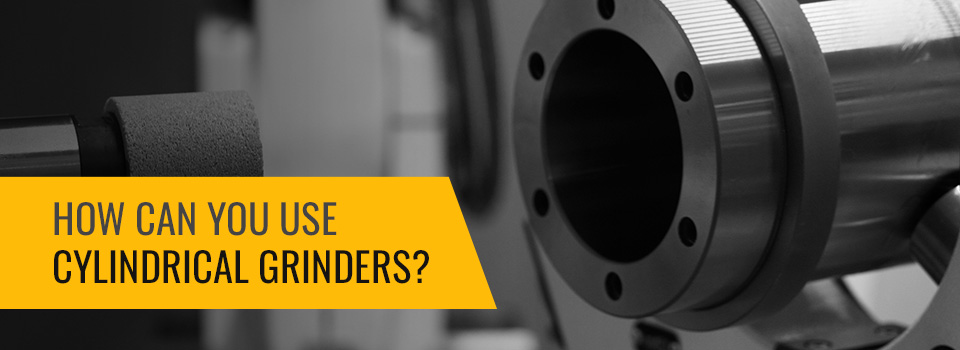
Do you manufacture metal parts? If your business produces metal objects with a central axis of rotation, you can use cylindrical grinding to ensure they have a smooth finish on the exterior and interior. This process is an effective way to smooth down several of the same types of objects.
Below, you’ll find more information about what cylindrical grinding is used for so you can determine whether it’s an effective process for your company’s metalworking needs.
What Is Cylindrical Grinding?
When you want to achieve a fine finish on a metallic surface, you can use cylindrical grinding. Most commonly, cylindrical grinding is used for grinding pieces with a central axis of rotation, like rods and cylinders. This process involves using a cylindrical grinder, which is a type of machinery categorized by rotation style and wheel device.
There are several kinds of cylindrical grinders, each one serving different purposes. However, all of them accomplish a similar goal — to remove tiny bits of excess metal from aluminum, steel and other metal objects as the final step in a project. As a result, you have a smooth piece of metal for your specific application.
How the Cylindrical Grinding Process Works
During the cylindrical grinding process, the machinist sets the piece of metal between two centers, called head and tail stocks. When the machinist operates the machine, the cylinder rotates in one direction. Then, the grinding wheel moves in the opposite direction at a different speed to start grinding.
While that’s happening, the wheelhead, which is attached to the grinding wheel, moves the wheel in varying motions toward and away from the metal piece to achieve the smoothest finish. Sometimes, the table beneath the object shifts back and forth laterally at the same time. As each part works, they’ll move along the surface of the object to create a perfect finish free of any crevices or scrapes.
Keep in mind that because various types of cylindrical grinding exist, the above process may look slightly different based on what style you use to smooth your metal products.

Most Common Types of Cylindrical Grinding
Depending on the nature of your application, you may need to use different kinds of cylindrical grinding machines. This equipment can accomplish numerous styles of grinding — outside diameter (OD) grinding, inside diameter (ID) grinding, plunge grinding, centerless grinding and creep feed grinding.
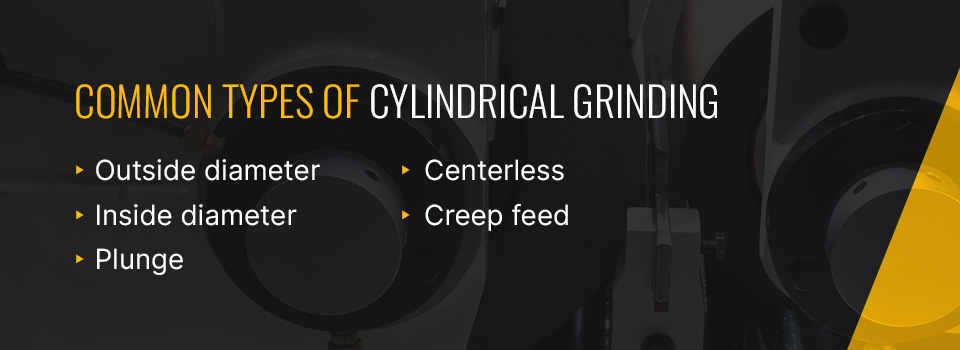
Here’s a closer look at each cylindrical grinding type to help you narrow down which one suits your business’s needs best:
- OD grinding: An OD grinding machine uses centers to rotate the object as it moves through the grinding wheel. As previously described, OD grinding involves the metal piece moving in the opposite direction of the grinding wheel. This type of grinding is strictly for exterior grinding purposes.
- ID grinding: ID grinding is the opposite of OD grinding, as it aims to finish an object’s interior. Therefore, the grinding wheel goes inside of the object. A collet, a kind of chuck, keeps the metal piece in place while simultaneously rotating it in the opposite direction to perform the grinding.
- Plunge grinding: A plunge grinding machine is used for a subset of OD grinding. Plunge cylindrical grinding concentrates on one part of the metal piece, as the grinding wheel continuously makes contact with a single area, rather than moving back and forth or up and down.
- Centerless grinding: When performing centerless grinding, machinists don’t need to secure the metal piece with a pair of centers or a collet. A centerless grinding machine uses a regulating wheel across from the grinding wheel. The object is set at an angle against the regulating wheel.
- Creep feed grinding: Instead of creating a seamless finish across the entire object, creep feed grinding removes a piece of the metal in one pass. This style uses a grinding wheel below a diamond dressing roller, which both operate in different directions. A creep feed grinding machine is best to use when you need to cut down your manufacturing time.
As you can see, choosing the appropriate cylindrical grinding style will depend on your application.
Typically, OD grinding is the guide style for cylindrical grinding, which you can use with other types when necessary. If you need to smooth the interior of a rod, you’ll likely need to use ID grinding in combination with OD grinding to get a completely smooth object inside and out. However, other uses may call for centerless grinding only.
With the knowledge of the basics of each grinding process, you’re better equipped to make the correct decision for your metalworking needs.
Common Industrial Uses for Cylindrical Grinders
While cylindrical grinding can work wonders for cylindrical objects, you can also use it to grind metal pieces in other shapes. So long as the object has a central axis of rotation, you can use cylindrical grinding to achieve a flawless finish. The main goal of cylindrical grinders is to create a surface with little to no roughness.
There’s a broad range of industrial applications for cylindrical grinding. Whether you need a smooth finish on rods, pistons, shafts, bearings or other kinds of objects, you can likely use cylindrical grinding to accomplish your goals. The most common industries that use cylindrical grinders are aircraft, plumbing, electrical and automotive.
Mainly, numerous industries use cylindrical grinder machines because they’re accurate, work 24/7 and allow for repeatability. In other words, you can create large batches of metal objects with smooth finishes around the clock. If you produce many of the same kinds of objects, you can ensure each one is as alike as possible when you use cylindrical grinding. This ease of production explains why cylindrical grinding is so popular.
Contact Hard Chrome Specialists for Reliable Outside Diameter Grinding Today
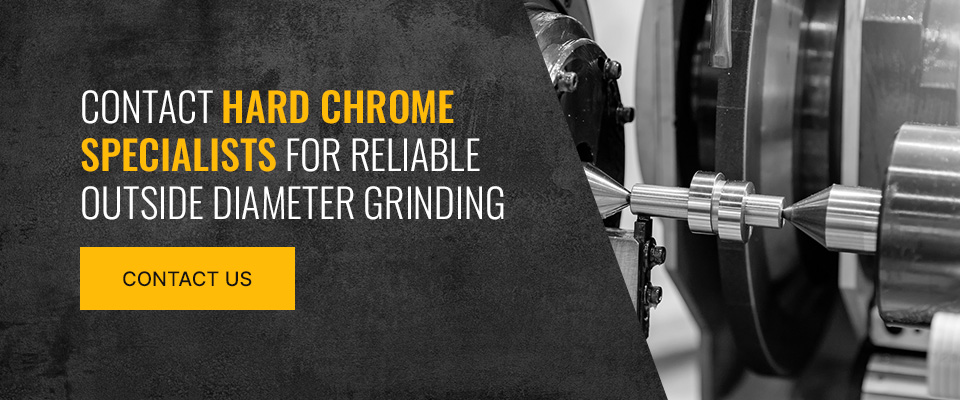
At Hard Chrome Specialists, we have decades of experience in the metalwork industry. From welding services to custom fabrication to cylindrical grinding services, we can help you achieve your metal manufacturing needs. Let us help you tackle your company’s metalworking needs with our quality services.
When it comes to cylindrical grinding, we exclusively use OD grinding to ensure the most precise finishes for various applications. Currently, we use an OD grinder that can accommodate shafts up to 25 inches in diameter and 159 inches long. The machine’s weight capacity is 8,000 pounds, so we can create a seamless finish for nearly any kind of metal you need us to process.
To learn more about our OD grinding process, contact us through our online contact form and our team will reach out as soon as possible.